




Introduction: Why Capitalization Still Deserves Attention
Capitalization is one of those writing rules that many people overlook, especially in casual or online content. It often feels minor, almost insignificant, but in reality, it plays a major role in how writing is perceived. Lake Texoma Should Be Capitalized When capitalization is handled correctly, it brings clarity, professionalism, and trust to the text. When it’s done wrong, it can quietly undermine the writer’s authority.
One phrase that commonly causes confusion is “Lake Texoma.” Many writers mistakenly believe it can be written in lowercase without consequence. However, this assumption ignores basic grammar rules that apply to proper nouns. Lake Texoma is not just a descriptive phrase—it is the official name of a specific geographic location.
This article explains why Lake Texoma should be capitalized, how grammar rules support this, and why correct capitalization matters in both professional and casual writing. By the end, you’ll clearly understand not only the rule itself, but the logic behind it.
Lake Texoma as an Official Proper Noun
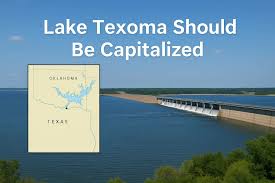
Lake Texoma is a proper noun, and that fact alone determines its capitalization. Proper nouns name specific people, places, or things, and they always begin with capital letters. Since Lake Texoma refers to a single, recognized lake located on the Texas–Oklahoma border, it qualifies fully as a proper noun.
The word “Lake” is not acting as a generic descriptor in this case. It is part of the lake’s official name, just like “Mount” in Mount Everest or “River” in Mississippi River. When these words are part of a formal name, they must be capitalized alongside the unique identifier.
Failing to capitalize Lake Texoma turns a specific place into something that appears generic. This can confuse readers, especially those unfamiliar with the area, and it diminishes the precision of the writing. Correct capitalization ensures clarity and accuracy.
Grammar Rules That Apply to Geographic Names
English grammar is very consistent when it comes to geographic locations. Names of cities, states, oceans, rivers, mountains, and lakes are always capitalized. This rule exists to help readers instantly recognize when a specific place is being referenced.
When you write “Lake Texoma,” both words must be capitalized because together they form the name of a particular lake. Writing “lake texoma” or “lake Texoma” is grammatically incorrect when referring to the official location. Those variations break established grammar conventions.
This rule applies regardless of writing style. Whether you are writing formally, casually, academically, or creatively, proper nouns retain their capitalization. Tone may change, but grammar rules do not disappear simply because the writing feels relaxed.
Common Mistakes Writers Make With Lake Texoma
One of the most common mistakes is assuming capitalization doesn’t matter in casual writing. Many people write the way they speak, forgetting that written language follows stricter rules. While conversational tone is acceptable, grammatical correctness is still important.
Another frequent mistake is inconsistency. A writer may capitalize Lake Texoma correctly at the beginning of an article but later switch to lowercase without realizing it. This inconsistency makes the content feel unpolished and can distract attentive readers.
Some writers also mistakenly believe that only “Texoma” needs to be capitalized, leaving “lake” in lowercase. This would only be correct if the word “lake” were being used generically, which is not the case when referring to the official name. Both words must be capitalized together to maintain accuracy.
Why Capitalization Builds Credibility and Authority
Correct capitalization directly affects how readers perceive your writing. When place names are capitalized properly, the content feels more reliable and professional. Readers may not consciously notice correct capitalization, but they definitely notice when it’s wrong.
Writing “Lake Texoma” correctly signals that the writer understands basic grammar rules and respects the subject. This is especially important in informational content, travel writing, educational articles, and business communication. Small errors can create doubts about the accuracy of the entire piece.
From an expert perspective, attention to detail is a sign of mastery. Capitalizing Lake Texoma correctly shows that the writer is deliberate, informed, and careful. These qualities help establish trust and keep readers engaged.
The Difference Between Generic and Specific Usage
Understanding context is key to capitalization. The word “lake” can be either a common noun or part of a proper noun, depending on how it’s used. For example, “We spent the afternoon at the lake” uses the word generically, so it remains lowercase.
However, when you say, “We spent the afternoon at Lake Texoma,” you are naming a specific place. In this context, “Lake Texoma” functions as a proper noun, and capitalization is required.
Writers often move between generic and specific references within the same piece of content. Being aware of this distinction helps ensure that capitalization is applied correctly and consistently throughout the article.
Professional Writing Standards and Consistency
Professional writing demands consistency, and capitalization is a major part of that. When place names are treated inconsistently, it signals a lack of editing or attention to detail. Even strong content can lose impact if basic rules are ignored.
In expert-level writing, consistency reinforces clarity. Capitalizing Lake Texoma every time it appears helps readers recognize it as a fixed, important location. It also improves readability by creating visual patterns that readers subconsciously rely on.
Whether you are writing for a blog, a report, a school assignment, or promotional content, following capitalization standards demonstrates discipline and professionalism. These qualities separate average writing from high-quality, authoritative work.
Conclusion: Lake Texoma Should Always Be Capitalized
There is no ambiguity when it comes to this rule. Lake Texoma should be capitalized because it is the official name of a specific geographic location. Grammar rules, writing standards, and professional conventions all support this conclusion.
Capitalization is not about being overly formal—it’s about being clear, accurate, and respectful of language. Writing Lake Texoma correctly improves readability, strengthens credibility, and reflects an expert understanding of basic grammar principles.
By applying this rule consistently, writers can instantly improve the quality of their work. Whether your writing is casual or professional, correct capitalization shows care, knowledge, and confidence. And when it comes to Lake Texoma, those capital letters truly matter.